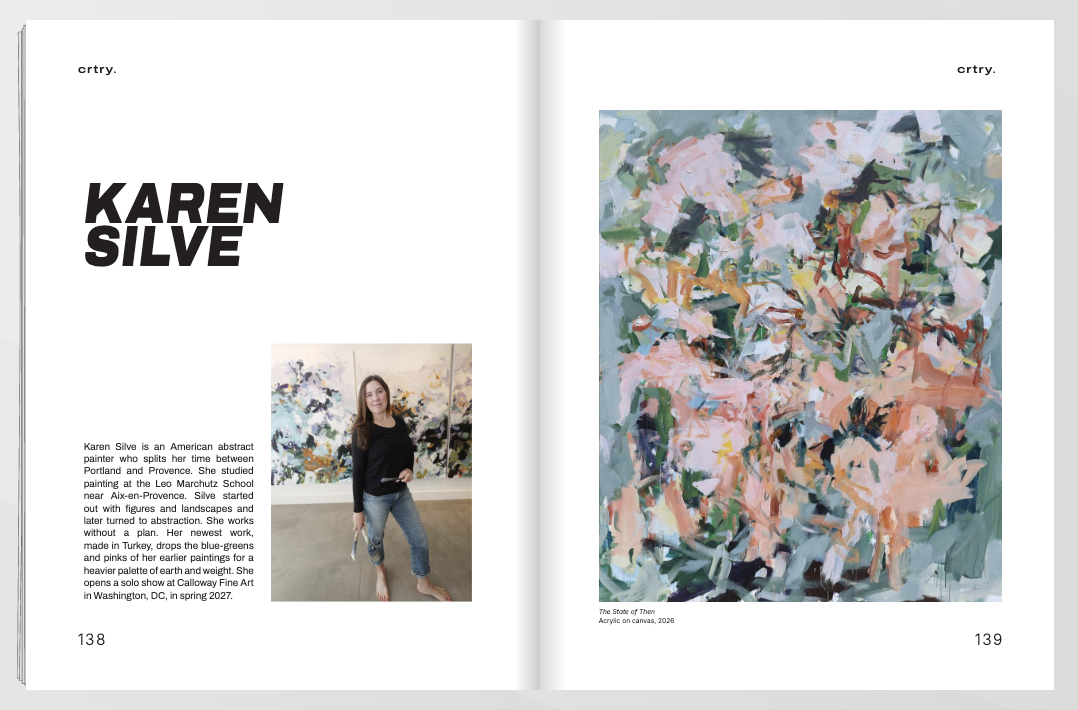
Curatory Magazine, Issue 18
Interview questions by Curatory
Publication Date: August 2026, Page 138-143
You began with figures and nature, then turned abstract. What led you there?
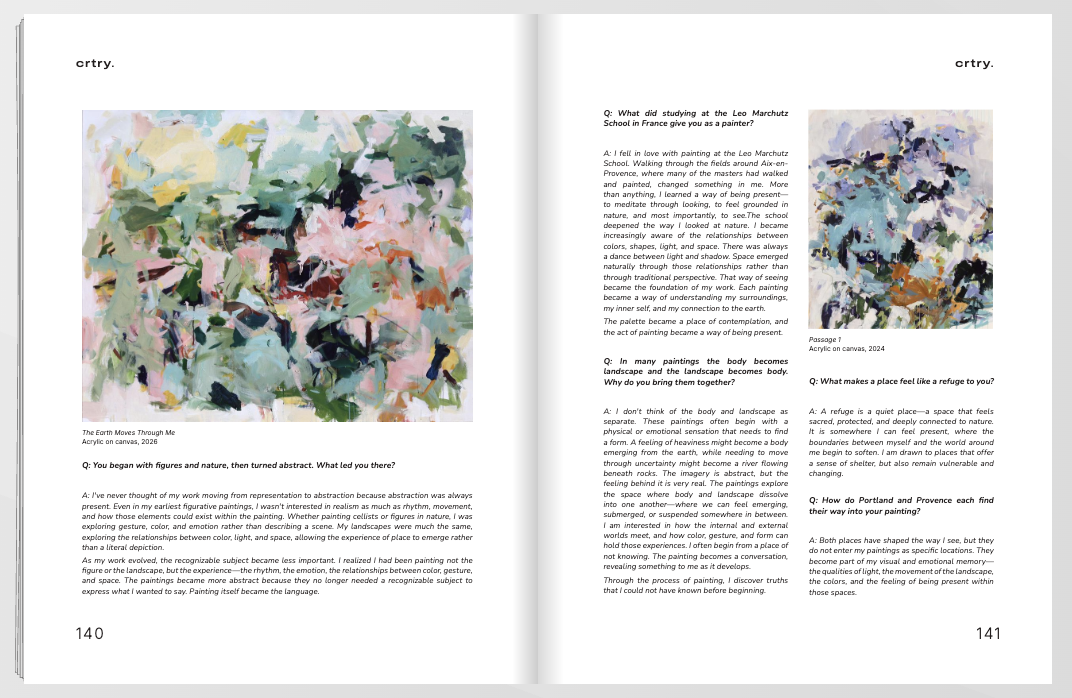
I've never thought of my work moving from representation to abstraction because abstraction was always present. Even in my earliest figurative paintings, I wasn't interested in realism as much as rhythm, movement, and how those elements could exist within the painting. Whether painting cellists or figures in nature, I was exploring gesture, color, and emotion rather than describing a scene. My landscapes were much the same, exploring the relationships between color, light, and space, allowing the experience of place to emerge rather than a literal depiction.
As my work evolved, the recognizable subject became less important. I realized I had been painting not the figure or the landscape, but the experience—the rhythm, the emotion, the relationships between color, gesture, and space. The paintings became more abstract because they no longer needed a recognizable subject to express what I wanted to say. Painting itself became the language.
What did studying at the Leo Marchutz School in France give you as a painter?
I fell in love with painting at the Leo Marchutz School. Walking through the fields around Aix-en-Provence, where many of the masters had walked and painted, changed something in me. More than anything, I learned a way of being present—to meditate through looking, to feel grounded in nature, and most importantly, to see.
The school deepened the way I looked at nature. I became increasingly aware of the relationships between colors, shapes, light, and space. There was always a dance between light and shadow. Space emerged naturally through those relationships rather than through traditional perspective.
That way of seeing became the foundation of my work. Each painting became a way of understanding my surroundings, my inner self, and my connection to the earth. The palette became a place of contemplation, and the act of painting became a way of being present.
In many paintings the body becomes landscape and the landscape becomes body. Why do you bring them together?
I don’t think of the body and landscape as separate. These paintings often begin with a physical or emotional sensation that needs to find a form. A feeling of heaviness might become a body emerging from the earth, while needing to move through uncertainty might become a river flowing beneath rocks. The imagery is abstract, but the feeling behind it is very real.
The paintings explore the space where body and landscape dissolve into one another—where we can feel emerging, submerged, or suspended somewhere in between. I am interested in how the internal and external worlds meet, and how color, gesture, and form can hold those experiences.
I often begin from a place of not knowing. The painting becomes a conversation, revealing something to me as it develops. Through the process of painting, I discover truths that I could not have known before beginning.
What makes a place feel like a refuge to you?
A refuge is a quiet place—a space that feels sacred, protected, and deeply connected to nature. It is somewhere I can feel present, where the boundaries between myself and the world around me begin to soften. I am drawn to places that offer a sense of shelter, but also remain vulnerable and changing.
How do Portland and Provence each find their way into your painting?
Both places have shaped the way I see, but they do not enter my paintings as specific locations. They become part of my visual and emotional memory—the qualities of light, the movement of the landscape, the colors, and the feeling of being present within those spaces.
Portland holds much of my personal history. I spent most of my adult life there, built my career as an artist, and developed deep friendships and connections within the community. Provence has been part of my life since childhood through visits to my grandparents, and now, living here as an adult, I experience it through a quieter relationship shaped by memory and reflection.
These places are never separate in my work. I bring Portland with me when I paint in France, and Provence with me when I return to Portland. They exist together as memories and internal landscapes.
What are you working on now, and what's coming up this year?
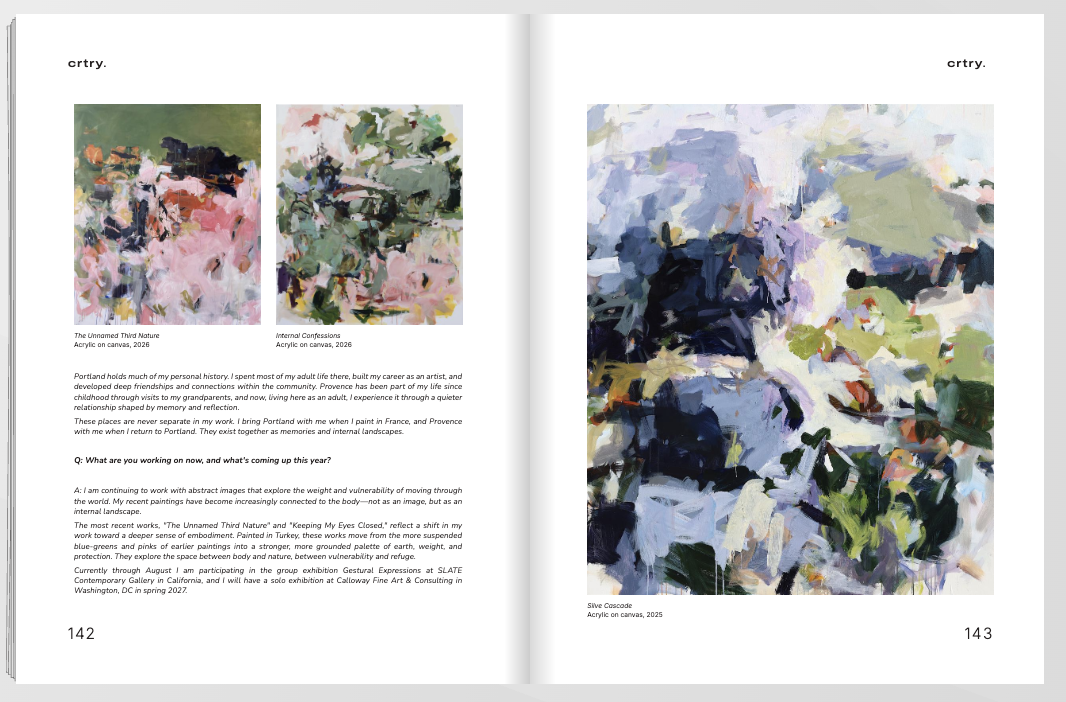
I am continuing to work with abstract images that explore the weight and vulnerability of moving through the world. My recent paintings have become increasingly connected to the body—not as an image, but as an internal landscape.
The most recent works, The Unnamed Third Nature and Keeping My Eyes Closed, reflect a shift in my work toward a deeper sense of embodiment. Painted in Turkey, these works move from the more suspended blue-greens and pinks of earlier paintings into a stronger, more grounded palette of earth, weight, and protection. They explore the space between body and nature, between vulnerability and refuge.
Currently through August I am participating in the group exhibition Gestural Expressions at SLATE Contemporary Gallery in California, and I will have a solo exhibition at Calloway Fine Art & Consulting in Washington, DC in spring 2027.
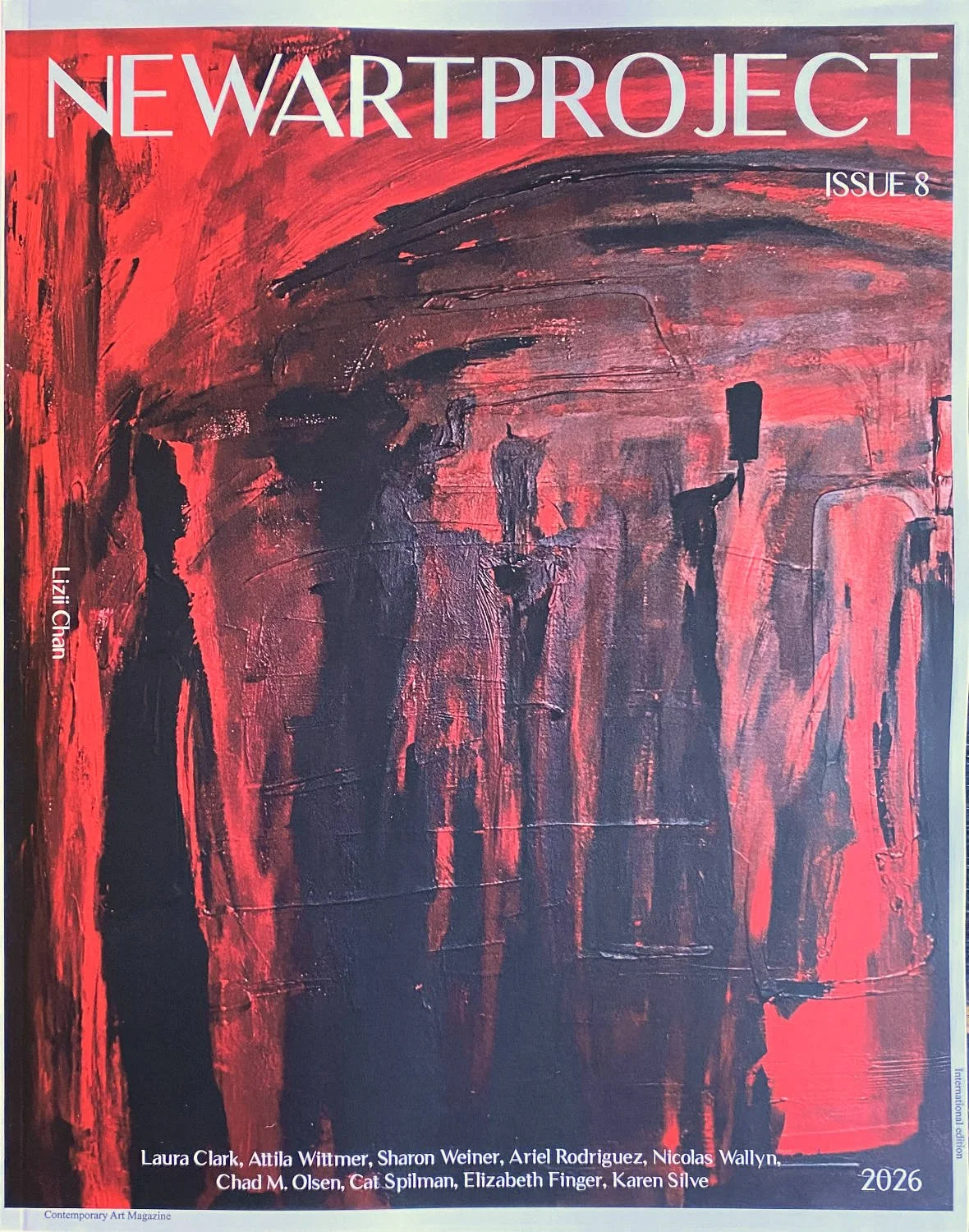




—Curatory Magazine, Issue 18
Publication Date: August 2026
Page 138-143